Posts

Calling Mr Hook in Charlotteville

Image
  Curtis Antoine continues the fisherman’s lifestyle inherited from his father, passing it on to his son. He speaks with Dr Anjani Ganase, marine scientist and explains how he has adapted his business as harvests from the sea change. The first time I worked with Curtis Antoine, he was introduced as “Amin” after the Uganda Dictator Idi Amin. This alias given to him during the days of Boy Scouts Jamborees in Trinidad for his serious demeanour stuck and labelled his intensity and the way he commanded attention. The Curtis I came to know is humble, courteous and wise. Safety on the sea is his key characteristic today and it is something he impresses on everyone that comes to his boat. Curtis and his son, Curtis Junior, are the owners-operators of Curtis Boat Tours. Curtis grew up on the waters around and beyond Charlotteville. When he was supposed to be in school, he would sneak away with his father, who was a fisherman. The sea was his master teacher and he le...

Connecting the dots from Sea to Shore

Image
Dr Anjani Ganase urges leaders and influential sectors in the society to consider the health of our ocean backyards. Connect the dots, she says, there is an urgent need to link land-based lifestyles with the life of the ocean, indeed the life of the planet. The Decade of Ocean Science for Sustainable Development (2021-2030) is upon us: will we use it to stem the degradation and revitalize the planet’s most precious resource? UNESCO has outlined a roadmap to improve the health of the ocean and to manage resources sustainably. Major challenges include understanding how marine pollutants impact ocean systems in order to mitigate impact, conserve marine biodiversity, and harvest the ocean sustainably to ensure food security. Further, could we build the capacity of ocean dependent states to address societal issues through ocean awareness? For the Caribbean, we need to build community resilience and disaster management with the use of early-warning systems against hurricanes, tsunamis and ev...

Endangered in the Antilles

Image
Falcons, parrots, parakeets are all near neighbours according to Faraaz Abdool who considers the fates of native parrots on some islands of the Lesser Antilles. All photos courtesy Faraaz Abdool  For those of us familiar with the Budgerigar – colloquially known as “budgie” – they are built for flight much like falcons are. Long, tapered wings and a long tail propel and guide a bullet-shaped body with ease at bone-shattering speeds. Even the mint-green Rose-ringed Parakeet, Europe’s first introduction to this family courtesy Alexander the Great in 327AD, shares these characteristics.   Delving deeply into the most recent revisions of avian taxonomy, one would encounter a pair of surprising neighbours. Falcons, within the order Falconiformes , famous for their blistering speed and ruthless accuracy, sit adjacent to Psittaciformes : parrots, cockatoos, and their relatives. Indeed, all these birds lie along the same spectrum. A look at Budgerigars in their...

The marine world in the age of dinosaurs

Image
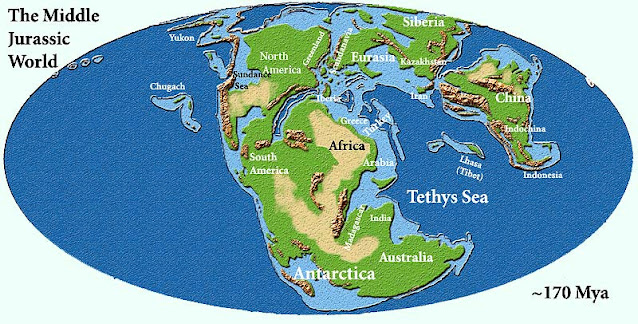
Do you ever wonder what lived in the ocean when the dinosaurs roamed the land? Dr Anjani Ganase shares what life might have been like in the Mesozoic. The dinosaurs roamed the earth for some 180 million years during the Mesozoic Era (252 – 66 million years ago). Hominids have been around for 11- 16 million years; and homo sapiens (us) for only the most recent 750,000 years. The Mesozoic Era (digest that - 180 million years!) is divided into three main periods: the Triassic, the Jurassic and the Cretaceous.   The Mesozoic Era followed the splitting up of the super continent Pangaea resulting in considerable volcanic activities and climatic shifts. As the land shifted to form the Atlantic Ocean, the Gulf of Mexico and other ocean basins, the global ocean called Panthalassa shifted into the Pacific Ocean. At the time, it is thought that global climate was much warmer than today with no ice at the poles and sea levels much higher. The separation of the continents contributed to the...

Antarctica the unknown

Image
  Dr Anjani Ganase discusses the most extreme environment on earth, the unknown continent, which has been positioned by the international community as a place of conservation, collaboration and human accord.   Extreme environment When learning about the seventh continent, Antarctica, it’s hard to really understand how alien this landscape is. On google maps, there’s nothing but a blank white visual. This is the coldest, driest and highest place on earth. Antarctica is covered in ice – in some locations five kilometres deep. It is a place that continues to defy human civilization, ancient and modern.   Antarctica has some of the lowest temperatures ever recorded – -89.2 C the lowest ever recorded on earth at Vostok Station. Geographically, Antarctica is two parts, East and West Antarctica divided along the Transantarctic mountains with eastern and western faces controlling the flow of ice sheets, either east or west. Mount Kirkpatrick is the hi...

Spotlight on Sharks

Image
Dr Anjani Ganase discusses the latest findings from research on sharks   Tiger sharks roam seagrass prairie in Bahamas Scientists have discovered the largest seagrass prairie in the world with the assistance of tiger sharks. Along the Bahamas archipelago, the area of seagrasses is estimated to be at least 66,900 km 2 with a upper estimate of 92,000 km 2 , which is roughly the size of Florida. This newly discovered area increases the known area of seagrasses globally by a whopping 41 %. The prairie consists of seagrass beds of varying species and densities, such as the turtle grass ( Thalassia testudinum ) but includes sparse areas of pioneer shoal grass species ( Halodule wrightii ).   While over 2500 surveys were conducted by divers, tiger sharks allowed researchers to extend the area of observation considerably as the tiger sharks were able to roam a much larger areas and swim to greater depth, beyond diving limits of humans (down to 90 m in the D...

Underwater at Man-o-War Bay

Image
There’s plenty to see just below the shoreline of most Tobago beaches. Anjani Ganase offers over and under water views from the Easter weekend at Charlotteville on the northeast of the island. Charlotteville is a favourite one stop shop for a weekend away. Slip into an easy village vibe. Then get to the beaches - so many little sandy coves - within the Man-o-War Bay. Go for a snorkel just offshore, or dive deeper. These sheltered beauties feel untouched and are not crowded. Man-o-War Bay is the largest deep water harbour for the island; and spans about five squared-kilometres. Rural and laid-back Charlotteville presents the iconic Caribbean island vibe, a contrast to the built up coastlines of southwest Tobago.   Rest House Reef, above and below the water, at Man-o-War Bay. Photo by Anjani Ganase Charlotteville Beach The main beach on Man-o-War Bay extends about one kilometre in length and is the focal point of a mainly fishing community. A walk along the beach is the typi...