Posts

Showing posts with the label Newsday Trinidad and Tobago

Speaking for the Ocean

Image
From the frontline of research on coral reefs around Tobago, Dr Anjani Ganase is seeing how human activities on shore affect life in the ocean. Here, she makes an appeal to consider five gifts for a healthy ocean. All photos by Anjani Ganase   World Oceans Day (June 8) was last Saturday, but maybe we should start thinking of our ocean every day, or at least for the month of June. Here are my five wishes for the ocean around Trinidad and Tobago. These confront the five main challenges that our marine ecosystems face. Here are some things that we can do as individuals, communities and a country to protect our piece of the ocean.   By becoming familiar with all our ocean ecosystems - like these seagrass beds in Bon Accord lagoon -  our children learn to love the ocean. Photo by Anjani Ganase Protect our marine biodiversity by law: Trinidad and Tobago is home to eleven environmental sensitive species, including five species of marine turtles, and th...

Sampling the World

Image
Faraaz Abdool reports from the international tourism marketplace ITB Berlin held in Germany in March. All photos courtesy Faraaz Abdool   The world’s largest tourism trade fair - commonly known as the ITB has been held annually in Berlin Germany since 1966.   The Internationale Tourismus-Börse which means “international tourism market,” seems to include all aspects of natural history and culture, from all over the world. Every year tourism players from across the world journey to Berlin to display, promote, and make new connections to improve their tourism industries, to enhance attractions and pull visitors.   It is an opportunity to network, learn and gain new insight into what might be marketable.   While government agencies such as tourist boards, ministries, and foreign offices occupy significant floor space, there are several exhibitors -   cruise lines, airlines, hotels, tour operators - that offer services to multiple countries. The UNESCO World ...

Developing the Home Market for Ecotourism

Image
  Pat Ganase encourages Trinbagonians to enjoy nature in these retreats on our islands. “Tobago has always had ecotourism,” says one environmentalist engaged in tourism. And Trinidad? The country’s best known ecotourism destination prides itself on attracting visitors from all over the world for close to 60 years. Who are these ecotourists that come from elsewhere, to be charmed by where we live here: the nature of forests and seashores and the animals and plants therein. Do they always need to be foreigners.   The best thing about eco-tourism is that everyone can enjoy it, learn from it and become better citizen stewards of our own country.   It does not require massive infrastructure, but does depend on strategic investments in long-term management of natural resources. Perhaps the most important foundation is respect for natural spaces. Any vision of individual or community must be enhanced and supported through policy, conscious use and the reliability of n...

Stories from Antarctica: ARRIVAL

Image
Dr Anjani Ganase writes about her travels on the Homeward Bound voyage to Antarctica and shares her photography. In the morning, the rocking of the ship had slowed to a gentle roll, a stark contrast to the rock and shudders of the previous two nights. We had finally crossed the Drake Passage. The Drake Passage sits between Cape Horn of South America and the South Shetland Islands of Antarctica. Here, three oceans - Pacific, Atlantic and Southern Ocean - converge making it one of the roughest stretches of water to navigate on the planet. You can pray for the Drake Lake, but most of the time you get the Drake Shake. The Island Sky was hoping to arrive at Elephant Island, the most easterly island of the South Shetlands and the place where Shackleton’s team were marooned but we deviated farther south to avoid a storm brewing in the area. We had regular swells of up to four metres with a few waves peaking over eight metres, but the crew insisted that the conditions were...

Timeless Travellers

Image
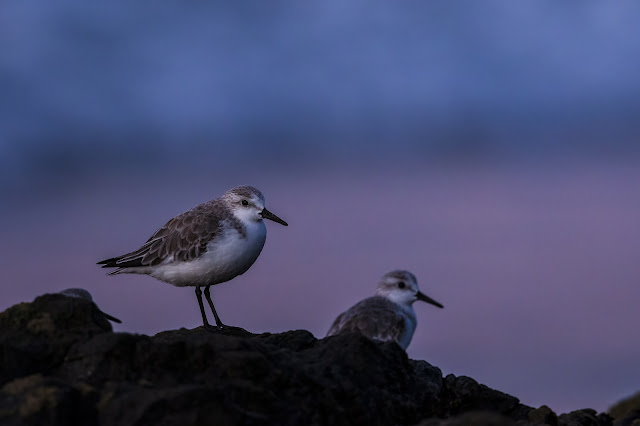
  Thousands of shorebirds set out on their maiden voyage from the frozen north to winter in the south. You’ll see many of them bobbing and running on beaches along Tobago’s coasts. Faraaz Abdool, birding enthusiast and photographer, champions the cause of creatures whose annual migrations take them from the north pole to the south in search of food. All photos by Faraaz Abdool     As the Earth hurtles around the Sun, its axis angles away from the flaming giant at the centre of our solar system plunging the northernmost regions into frigid darkness. The frosty fingers of winter crisscross land and sea, uniting them under white, featureless sheets of ice and snow. It is the boreal winter, a time associated with indoor activities and reunited families. We may huddle indoors making every attempt to insulate ourselves from the natural elements, but for the animals, their existence is the antithesis of this.   Hundreds of thousands of eggs hatch on the Arctic tun...

Tobago and Curacao

Image
  Dr Anjani Ganase looks at two similar Caribbean islands, two hours apart, with very different island ecosystems; and shares what we should learn from Curacao. All photos by Anjani Ganase   On a map, Curaçao is positioned as the mirror opposite to Tobago. Both share a vague resemblance to a cigar. Tobago is named for Tobacco. The origin of the name of Curaçao is unknown but thought to be given by the Arawaks who lived on the island. While Curaçao is 61 km long and 7 km wide, the island follows a northwest to southeast alignment, Tobago is shorter and fatter - 41 km long and 12 km wide - with a northeast to southwest alignment. It is the islands’ locations, geological histories and ecologies that make Curaçao and Tobago so distinctive with regard to their considerable natural wonders and biodiversity. View from Mt Christoffel, highest point on Curacao, shows an expanse of scrubland Tobago's Main Ridge Forest Reserve On the shoulder of South America C...