Posts

Showing posts with the label . Anjani Ganase

The Rise of Bird Flu

Image
  Dr Anjani Ganase warns that we should pay attention to the most recent rise of the Avian Influenza (H5N1) which is wreaking havoc among domestic and wild populations of birds. Here is what you need to know.   A brief history of Avian Influenza (H5N1)   Avian Influenza first arose in the nineties in farmed geese in Southern China, resulting in the die off of 40 % of the farmed population in the area before spreading across Asia, Africa and Europe. The avian influenza has resulted in deaths of millions of farmed birds with some transmission to wild bird populations, as well as some cross over infections to humans as a zoonotic disease.   In Southern China, Guangzhou province is sub-tropical with a long humid summer season supporting a wetlands and river systems used for farming and agriculture. It is also a major wintering ground for migratory birds.   Around the time of the first major avian outbreak in 1996, China had ramped up its poultry farming by 3...
The Latest Research from the Ocean

Image
Although the ocean occupies more area than the land, land-based species are impacting the ocean in untold ways.   Dr Anjani Ganase looks at some findings from current research in ocean science. Deep ocean impacts from hurricanes Scientists from New Zealand discovered that some cyclones in the Pacific Ocean may leave behind a biological marker in the ocean that is stored in the sediments of the ocean. Scientists observed a large phytoplankton (micro-organisms living suspended in the water) bloom following Cyclone Oma off the coast of Vanuatu. Cyclones form as the ocean surface heats up. The cyclone cools any area in its path by churning up the water and at times even drawing cold and nutrient rich waters up from the deep. The phytoplankton take the opportunity to feed on the nutrients and multiply. In nearshore environments, cyclones ejected large amounts of water over land masses resulting in significant run off of land-based nutrient that results in algal ...

Carnivals of the Sea

Image
From time to time, bandleaders have been inspired by and chosen to represent themes of the sea. Irving “Mac” McWilliams who was a fisherman at Las Cuevas created Wonders of Buccoo Reef to win the Band of the Year title in 1971. Peter Minshall’s Carnival of the Sea was the Band of the Year in 1979. Individual portrayals have dramatised sea creatures as giant, fearsome, awe-inspiring. Anjani Ganase, marine biologist, comments on some spectacular sea mas from the past.     Peter Minshall presented a Carnival of the Sea in 1979 and won the Band of the Year prize. His performance section was called Sea Serpent. Individually, the costumes encouraged sinuous movements. Together, the section created and moved in conga lines.   Although sea snakes are not found on coral reefs in the Caribbean, their presence in the Indian and Pacific Oceans is regarded with fondness. They are visual wonders underwater. While sea snakes are highly venomous, they are not aggressive. There ...

Vouch for Tobago and Trinidad

Image
Anjani Ganase offers an idea for recreation and accommodation businesses in Tobago. She wonders whether customers are willing to pay forward for their next vacation, dive session or restaurant meal; and whether business owners might mount campaigns to sell future activities, online.   Over the next weeks, while most businesses are allowed to function as normal, those that we rely on mostly for our enjoyment, entertainment and rejuvenation are once again forced to close. Deemed non-essential, these businesses will receive another blow to their livelihoods. Even with our borders closed, we had for a certain time some privileges that allowed us to comfortably escape to our sister island, to the beaches, cinemas and restaurants. Now this luxury has come to an end with confirmation that we have community spread of the Covid 19 virus. Beaches, cinemas, dine-in restaurants are closed, and the air and sea bridge is restricted to essential travel. Summer staycation...

Harvesting Blue Blood

Image
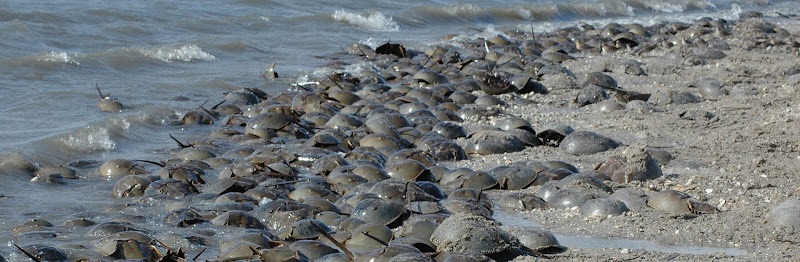
So who donates this primary ingredient for medical research and the development of vaccines? Dr Anjani Ganase discusses our connections to the ancient horseshoe crab.   The horseshoe crab – if I want to be overly dramatic – is the most alien creature that I have ever come across. During my first year studying in Florida, we observed the gathering of horseshoe crabs along the water’s edge of a beach. From above, this crab looks like a mobile helmet without a body crawling slowly across; turn it over and, the wriggling legs around a mouth gives the appearance of a baby alien. Sometimes there is a micro biome of worms and other critters that infest the underside of the horseshoe crab.   The horseshoe crab is actually not a crab. Rather it is a close relative of spiders and scorpions. There are four species existing today; one species, the Atlantic horseshoe crab ( Limulus polyphemus ), can be found along the eastern coast of USA and along Mexico. The other three species a...

Snorkelling Adventures in Tobago

Image
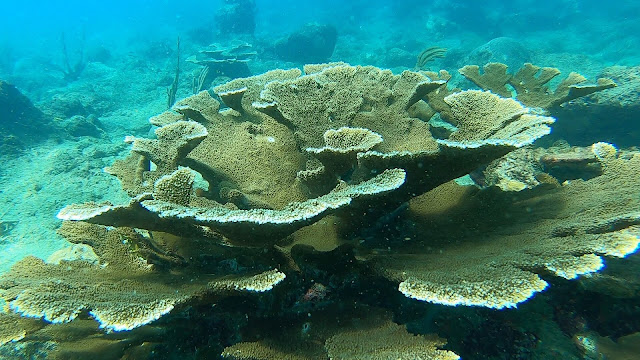
Around Tobago’s coast, riches abound. Dr Anjani Ganase encourages you to swim beyond the beaches to explore a world of corals and fish as rich as the rainforest.   Many people think that the only coral reef in Tobago is Buccoo Reef, but coral reefs line the rocky edges of most swimming bays around Tobago. All you need to explore the marine life is a mask, snorkel and a pair of fins. Wherever you head out to snorkel, make sure you look for submerged rocky areas that are found along the headlands of each bay; marine life tends to congregate and grow in these areas. Take a peek at the sand every so often to spot cryptic sand dwellers such as rays, flounders and even crustaceans that hide out in the sand. Here are some of my favourite snorkel sites for Tobago. Whirly Elkhorn Corals of Castara Bay. Photo by Jonathan Gomez   CASTARA REEF The best access to this reef is from Heavenly bay on the eastern side of Castara bay. This little bay is often visited by stingrays and r...