Posts

Showing posts with the label coral bleaching

Growing Corals against Global Warming

Image
Dr Anjani Ganase, coral reef ecologist, reviews current research and activities for coral reef conservation Extremely warm waters have hit the Caribbean, the second year in a row. In 2023, mass bleaching was observed throughout the Caribbean then the rest of the world. At the beginning of this year the fourth global coral bleaching event was declared, the second within the last decade. We seem to be well on our way to 99 % loss in coral populations by 2050 with the current trajectory of global emissions. Since I returned to Trinidad and Tobago to study reefs here, I have been reporting on coral bleaching every year. The severe coral bleaching last year decimated reefs throughout the Caribbean including the Meso-American Barrier Reef (Mexico and Belize), Jamaica, and Bahamas. In Tobago, many brain corals bleached and died last year, and in 2024, many colonies started to pale and bleach as early as July. The reefs have little time to recover between the hot summer ...
From the Caribbean to Antarctica

Image
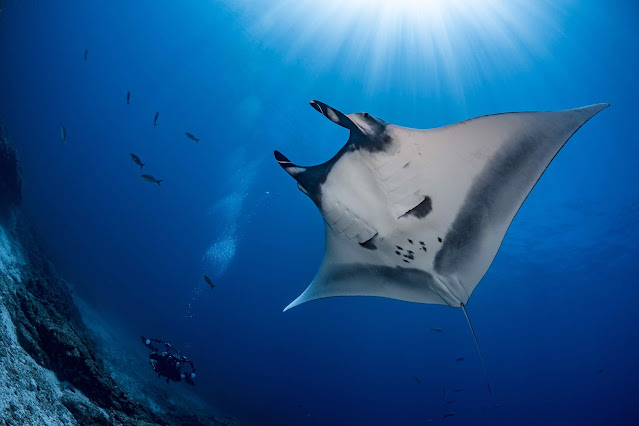
Dr Anjani Ganase provides a review of recent scientific studies on Manta rays, tropical forests, Antarctic sea ice and coral reefs. Manta Ray nursery off Florida   Monitoring of the giant oceanic manta ray ( Mobula birostris ) populations along the southeast coast of Florida has led scientists to believe that there is a manta ray nursery. Most of the mantas observed in the area were immature. This nursery would be one of three identified globally. The tracking of manta species over the years within this specific area reveal a high return to the area; some individuals were recorded multiple times over the four-year window.   Manta ray with diver, Socorro. Credit:  Hannes Klostermann / Ocean Image Bank Manta rays are relatively understudied yet the giant oceanic manta ray is endangered according to the IUCN (International Union for Conservation of Nature) red list. Genetic research also indicates the Western Atlantic rays may be a distinct species...

Caribbean Coral Reefs at Risk

Image
Among the most vulnerable to climate change are tropical coral reefs and the ecosystems that nurture many juvenile fish. Coral reef ecologist, Dr Anjani Ganase, raises the alarm for severe heat stress over the next months.   Coral Reef Watch (NOAA) for the Caribbean is predicting severe coral bleaching throughout our region from July to October. A bulletin was released in June by the Caribbean Institute for Meteorology and Hydrology using NOAA’s Coral Reef Watch four-month outlook (https://coralreefwatch.noaa.gov/index.php).   What is coral bleaching? Tropical corals have formed a special relationship with microscopic algae that live in the tissues of corals and give them the vibrant colours we associate with coral reefs. The microalgae photosynthesise using the sunlight and produce enough energy to supply themselves and their coral host. In return, the coral protects the algae from predation and supplies them with essential nutrients and the remov...

Coral Bleaching on the Great Barrier Reef

Image
  Dr Anjani Ganase talks about die-off of the most vulnerable creatures on the planet to global warming - corals.   Bleaching is happening today and on the coral reefs around Tobago; and this planetary indicator does not bode well for humanity.   Over the past week, marine scientists from the Great Barrier Reef Marine Park Authority have observed coral bleaching on the Great Barrier Reef (GBR). Certain areas are being described as severe, particularly along the central GBR near Townsville, a community largely dependent on the reef ecosystem for jobs and livelihoods. This year (possibly for the first time) the reefs are experiencing above average warming conditions, despite being in a La Niña phase. La Niña is associated with higher rainfall and cloud cover, conditions associated with cooling oceanic conditions. Nevertheless, many parts of the central and southern sections of the GBR are experiencing 0.5 - 2 degrees Celsius above the average temperature, while the nort...

Warning: The Caribbean Sea is Heating up!

Image
The warming water of the Caribbean Sea has implications for more than storms and hurricanes. Coral reef ecologist Dr Anjani Ganase warns of other dangers in the warming ocean. The outlook for coral reefs around Tobago – and impacts on livelihoods - ten years after the last significant event looks grim.   These days we can feel the heat on the land and in the sea. With the increasing effects of a warming world and the changing climate, the months of September and October are especially challenging for coral reef scientists. Forty years ago, the water temperature would – on occasion - get too warm for corals. These days, ocean temperatures are rising annually to temperatures that may be too warm even for tropical coral reefs.   Coral Reef Watch Coral Reef Watch was developed by NOAA (National Oceanographic and Atmospheric Administration, USA) following the first major global coral bleaching event in 1997 /1998. They realized that coral reefs around the world were bleac...

Coral Bleaching in the time of Covid-19

Image
Dr Anjani Ganase tells us how Covid-19 can bring us closer to freeing our species from its addiction to consumerism and save natural ecosystems   Over the past year, Australia has suffered from climate change fueled bush fires that last longer and burn more intensely than ever. In the past weeks, large sections of Australia’s Great Barrier Reef (GBR) are also “burning” under another mass coral bleaching event brought on by abnormally high ocean temperatures. This is the third major bleaching disaster in the recent five years and, as many scientists have predicted, the warming climate has caused an increase in the frequency and intensity of coral bleaching events (and bush fires for that matter) that result in mass mortality and loss to livelihoods.  Aerial view of bleached coral reefs (seen by the white colouration underwater) on the Great Keppel Islands, Southern Great Barrier Reef. Photo Credit: ARC Centre of Excellence for Coral Reef Stu...

Coral Bleaching: Threats for Tobago and the Lesser Antilles

Image
Ocean temperatures are reaching dangerous levels for coral reefs in the Caribbean, and international agencies have issued warnings. Dr Anjani Ganase, coral reef specialist, explains what these warnings mean for Tobago. What is coral bleaching? Corals form the foundation of our reef ecosystems by providing homes for an array of marine life. Corals are capable of building massive underwater structures because they form a special relationship with the microalgae that live inside the tissues of the coral. This is why corals are found in shallow well-lit tropical waters; the algae can photosynthesise using the sunlight and produce enough energy to supply both themselves and their coral host. In return, the coral provides the algae with a safe haven, storing the essential nutrients and removing the algae’s waste. The presence of the algae in the coral’s tissue makes coral reefs colourful and not transparent like their jellyfish cousins.  The breakdown of this relationsh...