Posts

Carnivals of the Sea

Image
From time to time, bandleaders have been inspired by and chosen to represent themes of the sea. Irving “Mac” McWilliams who was a fisherman at Las Cuevas created Wonders of Buccoo Reef to win the Band of the Year title in 1971. Peter Minshall’s Carnival of the Sea was the Band of the Year in 1979. Individual portrayals have dramatised sea creatures as giant, fearsome, awe-inspiring. Anjani Ganase, marine biologist, comments on some spectacular sea mas from the past.     Peter Minshall presented a Carnival of the Sea in 1979 and won the Band of the Year prize. His performance section was called Sea Serpent. Individually, the costumes encouraged sinuous movements. Together, the section created and moved in conga lines.   Although sea snakes are not found on coral reefs in the Caribbean, their presence in the Indian and Pacific Oceans is regarded with fondness. They are visual wonders underwater. While sea snakes are highly venomous, they are not aggressive. There ...

Leading the Way in Renewables

Image
Anjani Ganase visits Jamaica and considers their proactive approach to building resilience. She finds solutions in reducing plastic waste, diversifying energy sources but also diversifying administration of resources.   Jamaica has long been a tourism destination making the most of natural features like Blue Hole, photo by Anjani Ganase Jamaica is a major importer of oil and gas. However, the global economic crisis and the urgency of response needed for climate change have pushed Jamaica to develop a more resilient energy system, one that will withstand political crisis as well as natural disaster.   Their National Renewable Energy Policy (2009) focussed on energy conservation and diversification aims for 20 % renewables by 2030. Since 2020 Jamaica is relying on renewables to support 12 % of the national power demand – specifically 3 % hydroelectric, 6 % wind, 3 % solar. The rest of the energy system comes from clean natural gas (supplied by Trinidad...

Fantastic Parasites and where to find them

Image
Is it possible that a fungus could infect humans and over-run the world, like the cordyceps in the current hit tv series The Last of Us? Anjani Ganase discusses some fantastic parasites and where they are found.   We live in a weird and wonderful world of survival by any means necessary. Some organisms form symbiotic bonds, working together for survival. Some relationships are parasitic where one is robbed of its resources by another. Parasites occur across all the kingdoms. Here are a few parasites that have creatively mastered the art of survival.   Corpse flower ( Rafflesia keithii ). Photo courtesy Mike Prince from Bangalore, India, CC BY 2.0 <https://creativecommons.org/licenses/by/2.0>, via Wikimedia Commons Non- photosynthetic (parasitic) plants   Sounds like an oxymoron but did you know that there about 3000 species of parasitic plants in the world, making up about 1 % of the flowering plants clade. They are common to tropical forests around the ...

Life on the Edge of the Atlantic

Image
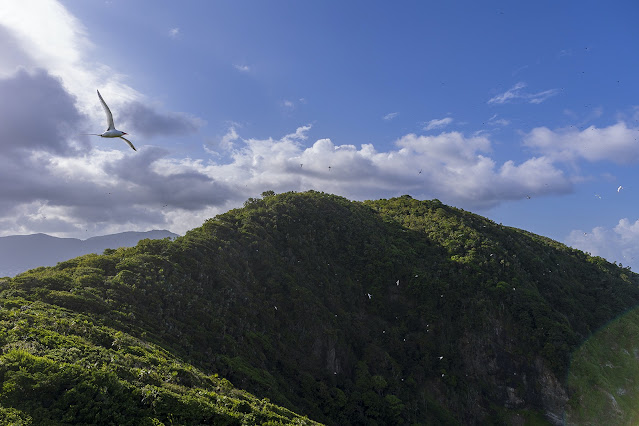
  Not just turtles spend their lives in the open sea returning to land only to nest. Some birds too live on the wing over water. Faraaz Abdool describes the life of the Red-billed Tropicbird which nests on Little Tobago. All photos courtesy Faraaz Abdool.   Little Tobago: sanctuary for Red-billed Tropicbirds Red-billed Tropicbirds may be seen from the "lookout" area on Little Tobago. Photos by Faraaz Abdool     It begins with the cracking of an egg, precariously placed in nothing more than a loosely scraped clearing on the precipitous slopes of Little Tobago. A ball of greyish fuzz emerges, a brand new Red-billed Tropicbird – an angel of the Atlantic. In the weeks before it develops the ability to fly, the young tropicbird enjoys a continuous delivery of fresh flying fish each day from both parents. Unaware of the trials and tribulations ahead, it grows quickly.   Young tropicbirds typically enter the world without a sibling. They aren’t alone, however...

Defend the Deep Ocean!

Image
An exhibition of art with ocean themes was mounted at the Trinidad Art Society on Saturday, January 14, by the Sustainable Ocean Alliance (SOA) to encourage its audience to restore the ocean and defend the deep. It was a significant event in their on-going project to raise awareness about the threats posed by Deep Seabed Mining. The Sustainable Ocean Alliance is working in support of a moratorium on Deep Seabed Mining sanctioned by the International Seabed Authority and likely to start as early as July this year, said Khadija Stewart, Coordinator of SOA Caribbean for Trinidad and Tobago. The Sustainable Ocean Alliance is a global non-governmental organization started in 2014 to mobilize a network of young people in support of the world’s oceans. SOA “has cultivated the world's largest network of next-gen leaders, entrepreneurs, advocates, mentors, and partners, working to create solutions for the largest challenges facing our ocean.” DEFENDERS OF THE DEEP ...

Considering the New Normal

Image
Two years after the worst effects on humans from the Covid-19 pandemic, Anjani Ganase reports on how it affected the natural world. The lessons still to be learned involve reducing human activities to allow nature to thrive.   During the 2020 Covid-19 lockdowns, there were numerous reports about the return of wildlife to urban spaces. These were the positive feel-good side notes while we were restricted in lockdown. Much of what was observed reveals the much-needed respite for the natural world from humans. Two years on, scientists have finished crunching the data on the significance of changes observed in natural ecosystems during lockdowns.   Here in Trinidad and Tobago, the beaches were closed for over a year.   Face mask at surface. Credit:  The Ocean Agency / Ocean Image Bank Our carbon footprint Apart from the obvious declines in traffic and congregating, the declines in outdoor activities equated to significant drops in carbon dioxide emissions at a ...