Posts

A Thousand Metres under the Sea

Image
At depths that could kill a diver, Dr Judith Gobin explores the deep ocean off Tobago and Trinidad. She talks with Dr Anjani Ganase (Twitter: @AnjGanase) about her adventures on EV Nautilus; and pleads for further scientific exploration and knowledge of these areas before they are destroyed .  “ I’ve always loved the sea. As a little girl, I enjoyed amazing vacations at Mayaro, fascinated by the sea, its animals and fish. Swimming, snorkelling and scuba diving became passions.” Dr. Judith Gobin is a senior lecturer in Marine Biology at the Department of Life Sciences and Deputy Dean for Undergraduate Affairs in the Faculty of Science and Technology, at the University of the West Indies (UWI). Her passion for discovery in the marine environment led her through university and the experience as a summer intern at the Institute of Marine Affairs solidified her career in marine biology. She spent 15 years in marine research at the IMA. Now she has over 35 years of research exp...

Light and Colour under the Sea

Image
In the International Year of the Reef 2018, Dr Anjani Ganase speculates how the loss of colour (through bleaching) on coral reefs might affect resident fish populations. Follow IYOR-T&T ( @IYORTT ) and AnjGanase ( @AnjGanase )  on twitter  Have a look around, and see if you can distinguish the shades and intensities of colours that surround you in different levels of light. Remind yourself how vulnerable you feel in the dark. We have evolved sensitivity to colour and intensities of light, a quality crucial for survival. In order to forage for food efficiently, primates must distinguish between red and green colouration, so that in the forests we can pick out the ripe fruits, and also identify any danger lurking among the foliage (Gerl and Morris 2008). For many animals, colour along with other cues, assisted in mating; consider the plumage display of male birds or changes that indicate the females are fertile. For modern man, not being able to colour coordinate m...

Connected by the ocean

Image
Water, the ocean, the medium for life, connects us all. Let it not divide us. Dr Anjani Ganase, marine scientist, looks into appreciating water connectivity for maintaining healthy reefs around Tobago in the International Year of the Reef 2018. (Follow her on Twitter: @AnjGanase ). First published in the Tobago Newsday, Thursday 12th April, 2018 The connectivity of the ocean facilitates processes such as exchange and transport of essential material (nutrients, oxygen and carbon dioxide), the migration of organisms and the dispersal of seeds and offspring between habitats. It allows marine turtles that hatch on our shores to hang out on reefs on other islands and to travel to other oceans. Whales, which prefer to raise their pups in warm waters, may grace us with Caribbean visits. Ocean connectivity allows coral reefs to be repopulated by fish and invertebrates from neighbouring reefs and from other habitats such as mangrove nurseries and seagrass beds. Reef views of Angel re...

The Importance of Coral Reefs in 2018

Image
This article is the first of a series that focuses on The International Year of the Reef 2018 and the T&T initiative. This week Dr Anjani Ganase, marine scientist, discusses the global impacts of climate change on coral bleaching, and the significance of actions to stem climate change 2018 is the International Year of the Reef (IYOR), a global effort initiated by the International Coral Reef Initiative (ICRI) to strengthen global awareness of the value of coral reef ecosystems. In Trinidad and Tobago, under the banner of IYOR T&T, a group of marine scientists in collaboration with other partners is launching a series of activities and programmes that showcase coral reef biodiversity, their value, the threats they face and opportunities for stewardship and protection. Currently, the effects of rising ocean temperatures compounded by pollution, plastics, sedimentation, overfishing and habitat destruction are threatening the future of coral reefs. Coral reefs are known to...

Treasures of the Bon Accord Lagoon

Image
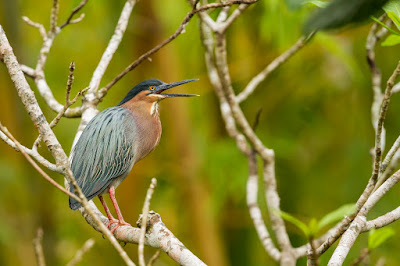
Faraaz Abdool discusses how the resident birdlife of Bon Accord Lagoon signals a welcome for visiting species; making this part of Tobago a birdwatchers’ haven. (All photos courtesy Faraaz Abdool; see faraazabdool.com) First published in the Tobago Newsday, March 29, 2018 One of the most densely populated areas in Tobago holds a treasured and under-appreciated secret. In low-lying marshy southwestern Tobago,  a vibrant and unique ecosystem supports all forms of life, from crabs that spend all their lives clinging to mangrove roots to birds that fly halfway around the world and back every year. During their breeding season, heightened hormonal levels cause subtle changes in the plumage of some species of Herons such as this Green Heron. The Bon Accord Lagoon and surrounding wetlands have unfortunately been described as “barren” and in need of “development” – as if it isn’t already a complex, functioning system of critical players essential to the survival of not only...

Understanding the Impact of Climate Change on our Oceans

Image
Dr Anjani Ganase, marine scientist and environmentalist, explains climate change, and how its effects may appear in different places at different times, or not at all in some other places. Understanding climate change and its effects is urgent for small island states. Over the years, discussion of human-induced global warming has slowly transitioned to climate change as scientists began to realise the broader effects of industrial carbon dioxide (CO 2 ) emissions on our planet. While global warming refers specifically to the increase in global temperatures of the atmosphere and oceans, (as a result of the heat trapping capabilities of carbon dioxide emissions - the green house effect), climate change refers to the many other changes directly as a result of CO 2 or because of the rise in atmospheric and oceanic temperatures. Some other physical phenomena that are occurring as a result of higher CO 2 levels and/ or rising temperatures include changes to the physical and chemical n...

Observing earth from space

Image
Dr Anjani Ganase, marine biologist and environmentalist, takes us into space for a perspective on Earth, our planet, and our home This piece is dedicated to Dr Stephen Hawking (1942 - 2018). As a pioneering theoretical physicist and cosmologist, Dr Hawking's work and life exemplified the term - reaching for the stars. Since the dawn of humankind, we are always looking to the stars for answers. Within this century, we succeeded in sending men and instruments into space to observe and record the cosmos. The satellites that orbit earth either point to the stars collecting information, or point to the earth relaying messages around the planet. It was in 1972, when the crew of the Apollo 17 took a moment to photograph the earth on their way to the moon, sending back the famous photo - not the first of its kind - that referred to the earth as “the blue marble.” Here was the definitive image that showed us our planet dominated by water. This photo of the blue marble displayed the...