Posts

What Coral Reefs tell us about Climate Change

Image
This week, Anjani Ganase, marine biologist, shares new knowledge about Australia’s Great Barrier Reef. With a relatively newer history, Caribbean reefs and first peoples may have information important to survival on our islands; it’s time to observe and research our own environment and record the traditional stories. This feature was first published in the Tobago Newsday, on Thursday November 3, 2016. Follow Anjani on twitter @AnjGanase The Great Barrier Reef (GBR), one of the largest natural structures on planet Earth, is visible from space. This natural wonder is about 2300 km long and 344 400 km 2 in area, larger than the UK, Switzerland and The Netherlands combined. It is one of the most diverse ecosystems in the world, home to as many as 6000 marine organisms, including species of corals, invertebrates, fish, marine mammals, sharks and turtles.   The reef is also ancient, over 500,000 years old; over this time the edge of Australia’s continental shelf and th...
Caribbean Reefs after Columbus

Image
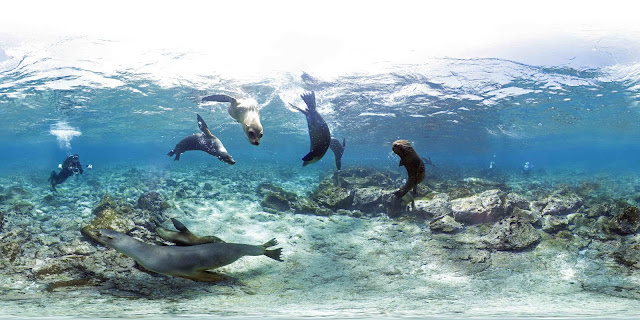
This week, marine biologist Anjani Ganase reviews the scientific article “Reefs since Columbus” written by ecologist Dr. Jeremy Jackson (1997) highlighting the history of degradation of Caribbean marine ecosystems since the time of Columbus. The significant loss of key marine animals long before the advent of modern monitoring and research on coral reef health, indicates the problem of the shifting baseline and our failure to understand what a truly healthy (or unexploited) coral reef or marine environment might be like. This article was first published in the Tobago Newsday on Thursday, October 27, 2016. Follow Anjani on twitter @AnjGanase “Large vertebrates such as the green turtle, hawksbill turtle, manatee and the extinct Caribbean Monk Seal were decimated by about 1800 in the central and northern Caribbean…” – Dr Jackson 1997. The thrill of sharing a protected reef with these Galapagos Sea Lions, Galapagos. UNESCO World Heritage Marine Site. Ph...

For Love of Tobago

Image
Anjani Ganase, Trinbagonian marine biologist, believes that people and communities are just as important in shaping a place as the natural environment. Occasionally she intends to profile personalities that she considers curators of Tobago’s cultural and natural environment. This week, she invites Lindsay Hall to speak about her Tobago. This feature was published first in the Tobago Newsday on Thursday 20th October 2016   Follow Anjani on twitter: @AnjGanase Tobago is a community of 61,000 persons who - although they share a common environment - still have unique experiences and stories living on this Caribbean island. This week Lindsay Hall tells her story, and relates why she became a yoga instructor and her hopes for change in Tobago’s education system. Lindsay is the daughter of Tony Hall, dramatist, and Mary Hall the Canadian born educator who founded and still teaches and runs the Michael K. Hall Community School in Tobago. M.K. Hall was named for Lind...

Alternatives for Sustainable Tourism in Tobago

Image
Anjani Ganase, Trinbagonian marine biologist, continues her weekly exploration of islands and the ocean. Today, she looks at alternatives in sustainable tourism through conservation and education, and imagines applications for the tremendous diversity of our own Tobago. This feature was first published in the Tobago Newsday on Thursday October 13, 2016 Follow Anjani Ganase on twitter: @AnjGanase Although Tobago has been tied to Trinidad for the past 127 years (since 1889), it is distinctly different in a lot of ways. For one it has built its own reputation as the quintessential tropical Caribbean island. Over the years, more people remember travelling to Tobago on family vacations than to Trinidad. It is considered to be the truer Caribbean island, less altered and more pristine. Even Trinis know this because it is where we go for a holiday. Tobago has a group of dedicated visitors, and we want to preserve this following and maintain these connections. But do we think t...