On Track to Climate Disaster
In this week of the COP30 in Brazil, Dr Anjani Ganase warns of more severe climate disasters as the world races to overtop the 1.5C rise subscribed in The Paris Agreement a decade ago. As a small island nation, Trinidad and Tobago also needs to do its part.
Global Tipping points
Currently Today, the world has already reached 1.4 C warming over pre-industrial levels (the target is 1.5 C). Over the recent years, 2023 to 2025, we have seen the worst coral bleaching along tropical shores and island nations. The science confirms that for coral reef ecosystems, a tipping point at 1.2 C has paved a certain future where coral reefs are likely to no longer be functional marine ecosystems. Coral reefs house more than 25 % of the ocean’s marine biodiversity, so we can expect rippling consequences to fish stocks, food security and even coastal protection. It confirms what marine scientists knew and feared for the future of many coral reef systems for the foreseeable future.
The latest report on the Earth’s tipping points – The Global Tipping Points Report 2025 - was released by the University of Exeter, Stockholm Resilience Centre and several other international partners. It has confirmed that unless global temperature rise is kept below 1.5 C then the future of coral reefs is uncertain with many locations suffering transition from reefs where corals dominate to algae, and only a handful of hope spots where corals may continue to survive. Unless emissions reach net zero by 2050, then the recovery of the coral reefs by the end of century would be unlikely.

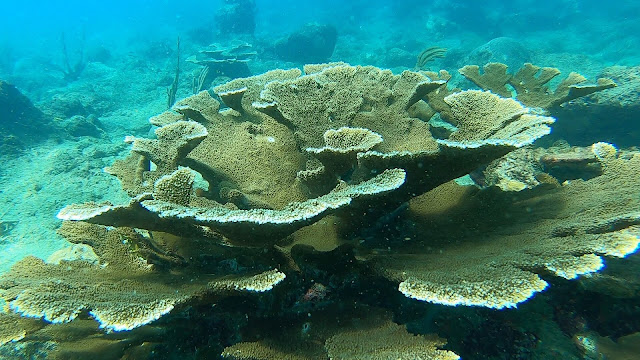
Coral bleaching in Tobago. Photo by Anjani
Ganase
Other systems that are nearing collapse are the polar ice sheets. It is expected that the Western Antarctic peninsula under current warming rates will have significant ice loss and mass loss of habitat for polar marine life – penguins, seals, walruses - and contribute to accelerating sea level rise. These tipping point impacts are cumulative and increase the vulnerability of small islands, most notably the low-lying Pacific Islands, now at high risk of being uninhabitable with invading seas and no coastal defence.
Unless we can stop greenhouse gas emissions abruptly, it is expected that global temperatures will rise over 1.5C in the next decade. Tipping points to look out for as we near 2C warming include the slowing of the ocean circulation, most notably the Atlantic Meridional Overturning Circulation (AMOC), that would completely upend our weather patterns, precipitating severe drought events in the Amazon and the Caribbean, along with colder and harsher winters in Europe. There are dire consequences to food and water security and infrastructure to withstand these changing conditions. Drought conditions and continued deforestation will result in significant die back of the Amazon and the loss of one of the world’s major carbon sinks.

River discharge into Castara Bay. Photo by
Anjani Ganase
Action needed in Trinidad and Tobago
For small island states, especially in the Caribbean, the combined impacts of climate change to our marine ecosystems and coastal areas will be a costly transition. Some will say that we would not know the difference - because let’s be honest, most people in Trinidad and Tobago do not connect the dots between the ocean and their livelihoods. We ignore the challenge to our peril, reflected in poor prioritisation by our leaders for sustainable management and protection in order to build resilience into our natural resources.
It is easy to blame the developed countries, and we have some right to do so, given the advantages developed at the cost of the shared ocean and air systems and poor accountability for their global pollution. However, the best defence against biodiversity loss amidst climate change (land and sea) is the enforcement of local marine protection and management laws, and strategies that build local resilience. Unfortunately, there has been little to no effective advancement in marine management over the last forty years to preserve healthy marine ecosystems, stable fish populations, increased biodiversity of species in designated sensitive areas, not even with the millions of external funding used to build capacity in marine conservation, science and policy and plan development. Plans and policies have been adopted but there’s been no effort or priority to act.
No matter how much we seek assistance from international agencies for funding to build capacity in the strategies for climate management, it does not negate the country’s own responsibilities to adopt and implement initiatives for the long term as part of the national responsibility. We must understand our own accountability or we will never move towards a solution.
Currently National Determined Contributions of many countries are limited and will fail to achieve the net zero target. Indeed, we are on track to global warming of over 2C by 2100. Trinidad and Tobago passed the new climate change policy this year, which includes objectives to reduce our carbon footprint, as well as objectives to conserve and build resilience of human and natural systems, all towards a climate adaptation strategy. What is now overdue is the passing of legislation, including the updating of the Fisheries Bill, enforcement of current and proposed marine protections, as well as the enforcement of many existing legislations, such as the implementation of management plans for environmentally sensitive areas and species. It remains to be seen whether the climate change policy will drive the work needed, but one thing is clear, unless we take care of our island ecosystem, no one else will do it.

Sargassum influx in Tobago. Photo by Anjani
Ganase
Positive tipping points
Not all doom and gloom, the Report puts a focus on some positive tipping points. Optimism comes largely from countries that have enacted policies to shift away from fossil fuels, towards alternative energy sources, as well as investments in new technology. There has been considerable acceleration to shift to solar power and the electric vehicle in many developed countries; however, some nations are back sliding on their goals. Demand has cut manufacturing costs for solar panels and improved the technology for battery storage. At the COP 30, currently being held in Brazil, Trinidad and Tobago needs to join the rest of the Caribbean and small island nations to advocate for holding to the Paris Agreement: 1.5 to stay alive! We also need to walk the talk in our own country.
Reference
Lenton, T. M., Milkoreit, M., Willcock, S., Abrams, J. F., Armstrong, McKay, D. I., Buxton, J. E., Donges, J. F., Loriani, S., Wunderling, N., Alkemade, F., Barrett, M., Constantino, S., Powell, T., Smith, S. R., Boulton, C. A., Pinho, P., Dijkstra, H., Pearce-Kelly, P., Roman-Cuesta, R. M., Dennis, D. (eds), 2025, The Global Tipping Points Report 2025. University of Exeter, Exeter, UK. ©The Global Tipping Points Report 2025, University of Exeter, UK.